Temporal Mini-Race Duration
This experiment tests the effect of temporal_mini_race_duration_ms on convergence and policy quality. In this project, reward and value estimation use a fixed-duration segment of the trajectory (a “mini-race”) rather than the full episode. In RL literature this is related to temporal abstraction (reasoning over trajectory segments; see Sutton et al. “Between MDPs and Semi-MDPs: A Framework for Temporal Abstraction in Reinforcement Learning”) and fixed-horizon or truncated-horizon reward — i.e. using part of the trajectory instead of the full run.
Runs: uni_12 (7000 ms), uni_13 (14000 ms), uni_14 (3500 ms). Baseline for comparison: uni_12 (7 s).
Experiment Overview
We compared segment durations: uni_12 (7 s), uni_13 (14 s), uni_14 (3.5 s). uni_12 ran ~55 min; uni_13 and uni_14 ~100 min; comparison is by relative time over the common window up to 55 min. The primary change in this experiment is segment duration.
Results
Important: Findings are by relative time (minutes from run start). Common window up to 55 min (uni_12 ended at 55 min; uni_13 and uni_14 ran ~100 min); metrics are compared at the same checkpoints (5, 10, …, 55 min).
Data source: Numbers are from scripts/analyze_experiment_by_relative_time.py (per-race tables: Hock = long track ~55–70 s, A01 = short track ~24–25 s). Reproduce: python scripts/analyze_experiment_by_relative_time.py uni_12 uni_13 uni_14 --interval 5 (--logdir <path> if needed).
Key findings (uni_12 vs uni_13):
uni_12 (7 s) converges faster: Hock (per-race explo) 69.61s by 20 min, 61.68s at 55 min; uni_13 still 78.73s at 55 min. A01 (eval) uni_12 24.85s by 20 min; uni_13 26.87s at 55 min.
At 55 min: Hock uni_12 61.68s, uni_13 78.73s → uni_12 better. A01 uni_12 24.85s, uni_13 26.87s → uni_12 better.
Training loss at 55 min: uni_12 102.84, uni_13 454.31 → uni_12 much lower (better).
RL/avg_Q_trained_A01 at 55 min: uni_12 -0.71, uni_13 -1.17 → uni_12 better (less negative).
GPU utilization similar (~69–74% uni_12, ~67–71% uni_13).
Key findings (uni_12 vs uni_14):
At 55 min uni_14 (3.5 s) has slightly better Hock (60.59s vs 61.68s) and slightly better A01 (24.74s vs 24.85s), much lower loss (46.78 vs 102.84), and better Q (-0.16 vs -0.71).
uni_12 converges much faster on A01: 24.85s by 20 min (uni_14 reaches 24.74s only by 55 min). Hock: uni_12 69.61s by 20 min, 61.68s at 55 min; uni_14 60.59s at 55 min (better final value but later).
GPU utilization similar (~71–74% uni_12, ~67–69% uni_14).
Conclusion (uni_12 vs uni_13): Over the common 55 min window, uni_12 (7 s) outperforms uni_13 (14 s): faster convergence, better race times (Hock 61.68s vs 78.73s, A01 24.85s vs 26.87s), much lower loss, better Q. Doubling the segment from 7 s to 14 s did not help.
Conclusion (uni_12 vs uni_14): At 55 min uni_14 (3.5 s) has slightly better Hock (60.59s vs 61.68s), slightly better A01 (24.74s vs 24.85s), much lower loss, and better Q. uni_12 converges much faster on A01 (24.85s by 20 min vs uni_14 by 55 min). So 3500 ms gives better final metrics at 55 min (loss, Q, Hock, A01) but slower convergence — mixed result: prefer 7 s for faster convergence; 3.5 s if you run longer and want slightly better final times.
Run Analysis
uni_12: temporal_mini_race_duration_ms = 7000, ~55 min
uni_13: temporal_mini_race_duration_ms = 14000, ~100 min
uni_14: temporal_mini_race_duration_ms = 3500, ~101 min
TensorBoard logs: tensorboard\uni_12, tensorboard\uni_13, tensorboard\uni_14. To reproduce (2+ runs supported): python scripts/analyze_experiment_by_relative_time.py uni_12 uni_13 uni_14 --interval 5 (or uni_12 uni_13, uni_12 uni_14; --logdir "<path>" if not from project root).
Analysis methodology
Same as in training_speed: the script uses per-race events (Race/eval_race_time_*, Race/explo_race_time_*) with one run-wide t0 per run so comparison is by relative time. At each checkpoint: best/mean/std, best among finished, finish rate, first finish. Scalars alltime_min_ms_*, loss, Q, GPU % at checkpoints.
Detailed TensorBoard Metrics Analysis
Methodology — Relative time: Metrics at checkpoints 5, 10, 15, …, 55 min; common window up to 55 min. Race times from per-race tables (Hock ~55–70 s, A01 ~24–25 s); loss/Q/GPU% = last value at that moment. The figures below illustrate each metric (one graph per metric, runs as lines, by relative time).
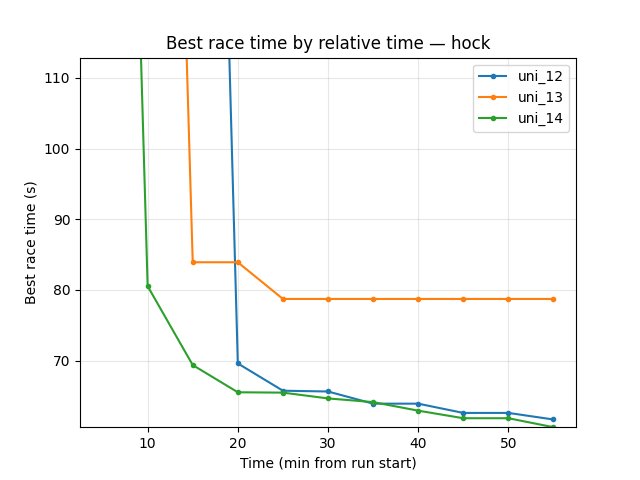
Hock (per-race explo_race_time_trained_hock)
uni_12: at 10 min 300s (no finish); at 20 min 69.61s; at 55 min 61.68s.
uni_13: at 10 min 80.54s; at 15 min 83.92s; at 55 min 78.73s.
uni_12 reaches good Hock earlier and is better at 55 min (61.68s vs 78.73s).
A01 (per-race eval_race_time_trained_A01)
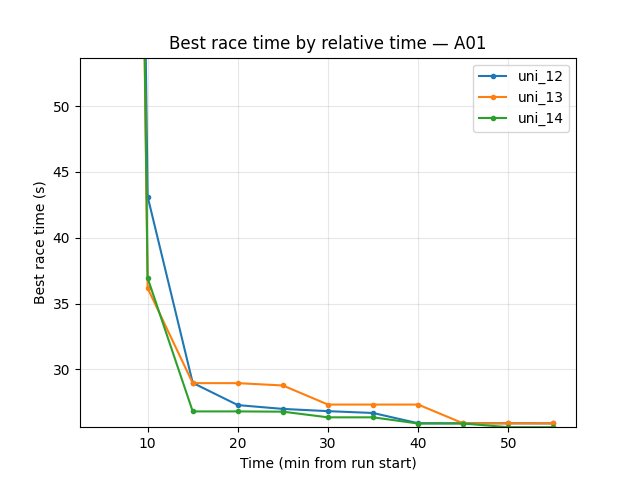
uni_12: at 20 min 24.85s; at 55 min 24.85s.
uni_13: at 55 min 26.87s (best in window).
uni_12 better on A01: reaches 24.85s by 20 min; at 55 min uni_12 24.85s, uni_13 26.87s.
Training loss
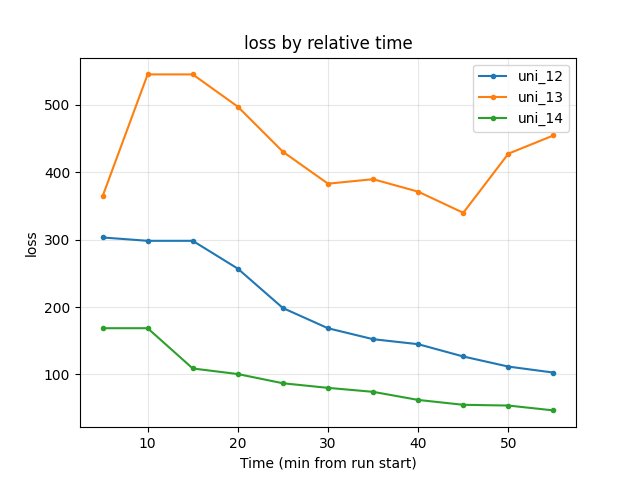
uni_12: at 55 min 102.84.
uni_13: at 55 min 454.31; higher throughout the window.
uni_12 much lower (better); uni_13 loss remains high over the common 55 min.
Average Q-values (RL/avg_Q_trained_A01)
uni_12: at 20 min -0.83; at 55 min -0.71.
uni_13: at 55 min -1.17; more negative over the run.
uni_12 better (less negative) at end of common window.
GPU utilization (Performance/learner_percentage_training)
uni_12: ~71–74% over the window; at 55 min 71.9%.
uni_13: ~67–71% over the window; at 55 min 69.6%.
Similar; uni_12 slightly higher.
uni_12 vs uni_14 (7 s vs 3.5 s segment, common window up to 55 min)
uni_14 — temporal_mini_race_duration_ms = 3500 (3.5 s segment). uni_12 ~55 min; uni_14 ~101 min.
Hock (per-race explo_race_time_trained_hock)
uni_12: at 20 min 69.61s; at 55 min 61.68s.
uni_14: at 15 min 69.38s; at 55 min 60.59s.
uni_14 slightly better Hock at 55 min (60.59s vs 61.68s); uni_12 and uni_14 both reach good Hock by 55 min.
A01 (per-race eval_race_time_trained_A01)
uni_12: at 20 min 24.85s; at 55 min 24.85s.
uni_14: at 40 min 26.56s; at 55 min 24.74s.
uni_12 converges much faster on A01 (24.85s by 20 min); uni_14 reaches slightly better A01 at 55 min (24.74s vs 24.85s).
Training loss
uni_12: at 55 min 102.84.
uni_14: at 55 min 46.78; lower throughout the window.
uni_14 much lower (better raw loss); but A01 performance worse, so loss alone is misleading.
Average Q-values (RL/avg_Q_trained_A01)
uni_12: at 55 min -0.71.
uni_14: at 55 min -0.16; less negative over the run.
uni_14 better (higher Q) at end of common window.
GPU utilization
uni_12: ~71–74% over the window; at 55 min 71.9%.
uni_14: ~67–69% over the window; at 55 min 67.2%.
Similar; uni_12 slightly higher.
Summary (uni_12 vs uni_14): At 55 min 3.5 s (uni_14) gives slightly better Hock (60.59s vs 61.68s), slightly better A01 (24.74s vs 24.85s), much lower loss, and better Q. uni_12 converges much faster on A01 (24.85s by 20 min vs uni_14 by 55 min). Trade-off: 3.5 s improves final metrics at 55 min; 7 s gives faster convergence.
Configuration Changes
Environment (environment section in config YAML):
# uni_12: 7000 ms (7 s) — baseline; fastest convergence; best vs uni_13 (14 s) over 55 min
# uni_13: 14000 ms (14 s) — worse than uni_12 over 55 min
# uni_14: 3500 ms (3.5 s) — at 55 min slightly better Hock and A01, lower loss, better Q; slower convergence on A01
temporal_mini_race_duration_ms = 7000  # or 3500 / 14000; see experiment doc
Note: temporal_mini_race_duration_actions is derived as temporal_mini_race_duration_ms // ms_per_action (e.g. 280 actions at 14 s with 50 ms per action). It affects state normalization, priority horizon (min_horizon_to_update_priority_actions in the training section), and buffer collate logic in buffer_utilities.py.
Hardware
GPU: RTX 5090 (same as other experiments)
Parallel instances: 8 collectors
System: Same across runs
Conclusions
7 s vs 14 s (uni_12 vs uni_13): Over the common 55 min window, uni_12 (7000 ms) converges faster and reaches better race times (Hock 61.68s vs 78.73s, A01 24.85s vs 26.87s), much lower loss, and better Q than uni_13 (14000 ms). Longer segment (14 s) did not help.
7 s vs 3.5 s (uni_12 vs uni_14): At 55 min uni_14 (3500 ms) has slightly better Hock (60.59s vs 61.68s), slightly better A01 (24.74s vs 24.85s), much lower loss (46.78 vs 102.84), and better Q (-0.16 vs -0.71). uni_12 converges much faster on A01 (24.85s by 20 min vs uni_14 by 55 min). Mixed: 3.5 s gives better final metrics at 55 min; 7 s gives faster convergence.
Recommendation: 7000 ms remains a good default for fastest convergence. Use 3500 ms if you run at least ~55 min and want slightly better final Hock and A01 and lower loss; avoid 14000 ms unless you re-test with longer runs.
Recommendations
Default: Prefer 7000 ms (7 s): fastest convergence; best vs 14 s (uni_13) over 55 min.
When to try 3500 ms (uni_14): If you run at least ~55 min and want slightly better final Hock and A01, lower loss, and better Q; 3.5 s converges slower on A01.
When to try 14000 ms: Only with longer runs; 14 s did not help over 55 min (uni_13).
Analysis tools:
By relative time (2+ runs):
python scripts/analyze_experiment_by_relative_time.py uni_12 uni_13 uni_14 --interval 5(--logdir "<path>"if not from project root). Output: per-race tables (best/mean/std, finish rate, first finish) then scalar metrics.Key metrics: Per-race
Race/eval_race_time_*,Race/explo_race_time_*; scalarsalltime_min_ms_hock,alltime_min_ms_A01,Training/loss,RL/avg_Q_trained_A01,Performance/learner_percentage_training(see TensorBoard Metrics Reference).