Experiment: Linesight-style RL on A01 vs A01_as20_long_v2
Experiment Overview
This experiment compares a run trained with Linesight-aligned hyperparameters on the A01 map cycle (run_name: linesight_A1, config based on config_files/rl/config_linesight.yaml / upstream Linesight-RL/linesight) against the established long-run baseline ``A01_as20_long_v2`` (default-style IQN on A01 with ``global_schedule_speed: 4``).
Goal: See whether the upstream Linesight recipe (160x120 CNN, IQN embedding 64, no DDQN, vanilla IQN without BTR, weight_decay_lr_ratio: 0.02, global_schedule_speed: 1, etc.) matches or beats the tuned Rulka long baseline on best A01 time, robust eval, and stability (mean time, finish rate), when both use batch 4096 and the same A01 map and reference line, but see map_cycle repeats below (not identical sampling mix).
Important: This is not a single-parameter ablation. Differences include schedule speed, vision resolution, IQN / target-update settings, exploration schedules, reward shaping (engineered slide bonuses and final_speed_reward_as_if_duration_s on v2 only), map_cycle exploration repeat (4 vs 64 per cycle block for linesight_A1 vs v2; see Configuration Changes), performance block (running_speed, network broadcast cadence; same gpu_collectors_count and ``max_rollout_queue_size`` in both snapshots), and BTR (explicitly off on linesight_A1; v2 snapshot has no btr: section and used the codebase defaults at run time — historically the tuned stack with DDQN / smaller CNN, not the Linesight vanilla recipe).
Results
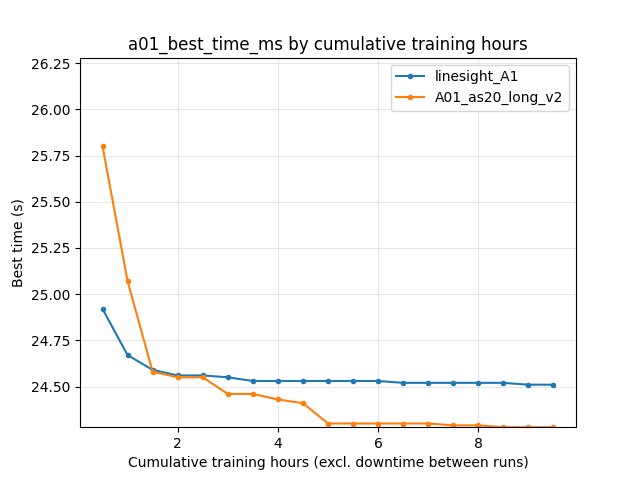
Primary outcome: On saved best A01 time from accumulated_stats.joblib, ``A01_as20_long_v2`` remains better: 24.150 s (24150 ms) vs 24.510 s (24510 ms) for linesight_A1.
TensorBoard / per-race (cumulative training hours, common window ~0–9.7 h):
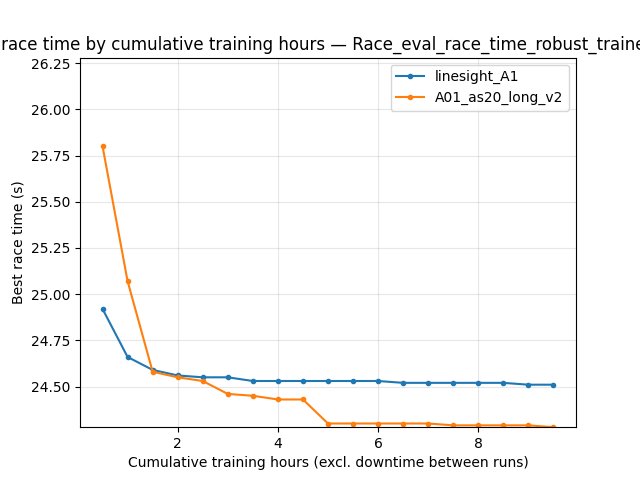
Robust eval best (
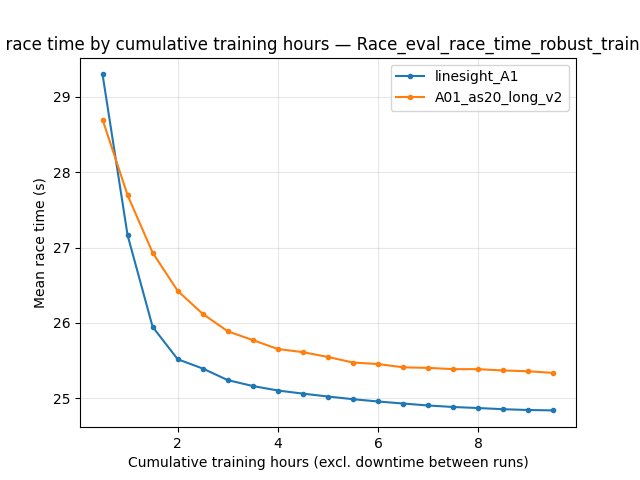
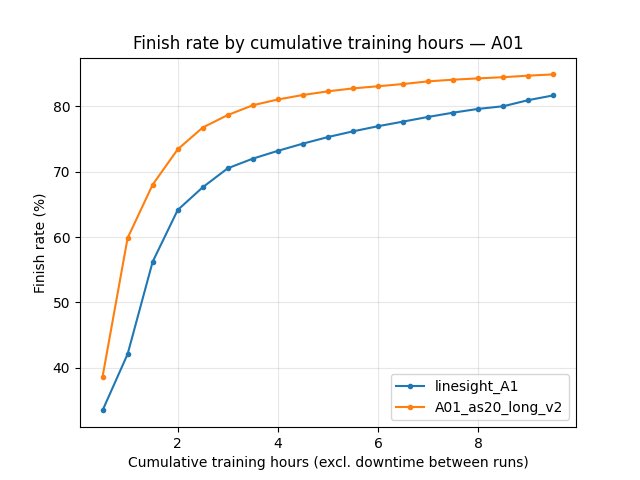
Race/eval_race_time_robust_trained_A01):linesight_A1improves to ~**24.51 s** by ~9 h; v2 reaches ~**24.28–24.29 s** in the same window (better).Eval mean time and finish rate favor v2 throughout the shared window (e.g. at 9 h cumulative training: trained-eval mean ~**105.6 s** vs ~**88.6 s**; finish rate ~**71%** vs ~**77%**).
By equal training steps (BY STEP, common window up to ~51M steps):
Early (e.g. 10M steps): robust best is similar (~**24.56 s** vs ~**24.58 s**).
Late (51M steps): v2 leads on ``alltime_min_ms_A01`` and robust best (~**24.28 s** vs ~**24.51 s**).
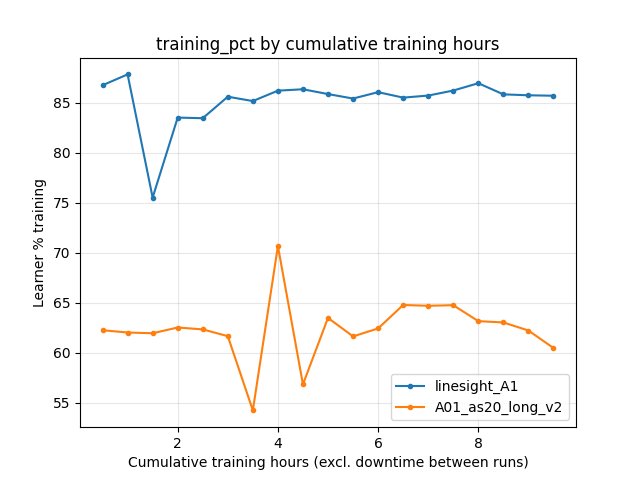
Learner utilization: linesight_A1 shows much higher ``Performance/learner_percentage_training`` (~**85–87%** vs ~**62–64%** at comparable steps). Both runs used eight collectors (see snapshots); the gap is not from 2 vs 8. Plausible contributors include ``running_speed`` (80 vs 32), weight/inference broadcast cadence (send_shared_network_every_n_batches / update_inference_network_every_n_actions), and heavier per-step compute on the Linesight-side vision stack (160x120 vs 64x64), which changes how the learner spends time relative to IPC and buffer work.
Run Analysis
``linesight_A1``: Linesight-style config on A01; TensorBoard merged across 5 dirs (
linesight_A1…linesight_A1_5). ~9.67 h cumulative training time (cumul_training_hours). Wall span from TB merge ~**580 min** (not equivalent to training time; short run).``A01_as20_long_v2``: Historical long baseline; TensorBoard merged across 3 dirs. ~17.74 h cumulative training time. Wall span ~**2902 min** (includes idle gaps; see Time axis conventions (experiment write-ups)).
Common comparison windows
By cumulative training time: compare up to ~9.67 h (when
linesight_A1stops).By steps: compare up to ~51M steps (max step in the shorter merged run).
Detailed TensorBoard Metrics Analysis
Methodology: Metrics are compared (1) on the cumulative training hours axis (--time-axis cumul_training_hours) and (2) in BY STEP tables (1M step grid). For long runs, wall-clock minutes from TensorBoard are misleading when the learner is idle between sessions; do not equate TB wall span with training duration. Command used:
python scripts/analyze_experiment_by_relative_time.py linesight_A1 A01_as20_long_v2 --time-axis cumul_training_hours --interval-training-hours 1 --step_interval 1000000
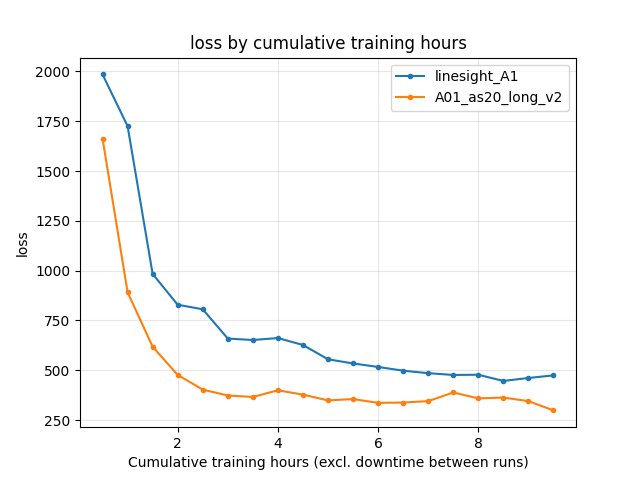
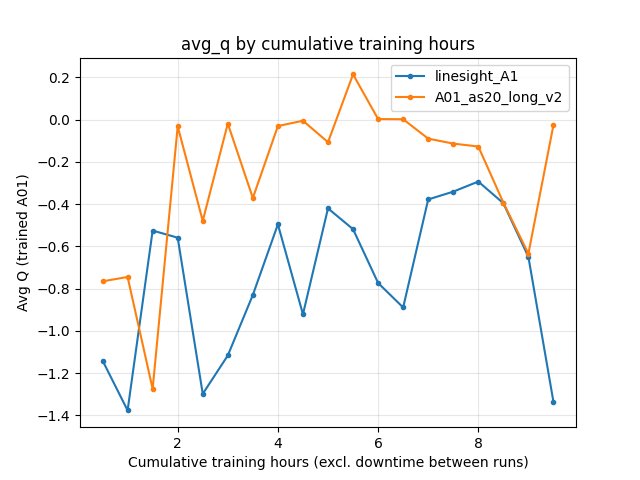
The figures below show one metric per graph (both runs as lines, cumulative training hours on the X axis where applicable).
A01 robust eval best (common window up to ~9.7 training hours)
At 9 h cumulative training, robust eval best is ~**24.51 s** (linesight_A1) vs ~**24.29 s** (A01_as20_long_v2).
A01 robust eval mean
Scalar alltime_min_ms_A01
Eval finish rate (trained A01)
Training loss
Average Q (RL/avg_Q_trained_A01)
Learner training percentage
BY STEP highlights (1M checkpoints, excerpt)
``Race/eval_race_time_robust_trained_A01`` best: at 10M steps ~**24.56 s** vs ~**24.58 s**; at 51M ~**24.51 s** vs ~**24.28 s** (v2 better at the end of the common step window).
``alltime_min_ms_A01``: at 51M steps ~**24.51 s** vs ~**24.28 s** (aligns directionally with save-state check below).
Save-state cross-check (mandatory)
Final bests from save/<run>/accumulated_stats.joblib (alltime_min_ms['A01'] in ms):
``linesight_A1``: 24510 ms (~**24.510 s**).
``A01_as20_long_v2``: 24150 ms (~**24.150 s**).
At the last common BY STEP checkpoint (~51M), TensorBoard alltime_min_ms_A01 shows the same ordering (~24.51 s vs ~24.28 s). v2 continued training well past that; its saved 24150 ms reflects the full long run, not only the shared window.
Configuration Changes
Training (representative deltas, from ``save/…/config_snapshot.yaml``)
# linesight_A1 (Linesight-style)
global_schedule_speed = 1
weight_decay_lr_ratio = 0.02
# epsilon_boltzmann second knot at 3M steps (Linesight)
# epsilon schedule knots match v2 for the listed steps (through 3M)
# engineered slide schedules: [[0, 0]] only; final_speed_reward_as_if_duration_s = 0
# multi_action_exploration: per_action (present in linesight snapshot)

# A01_as20_long_v2 (baseline)
global_schedule_speed = 4
weight_decay_lr_ratio = 0.1
# epsilon_boltzmann second knot at 10M steps
# engineered speedslide / neoslide schedules with mid-training bonuses; final_speed_reward_as_if_duration_s = 2
# multi_action_exploration: omitted in snapshot (schema default at run time)
Neural / algorithm
# linesight_A1
w_downsized = 160, h_downsized = 120
iqn_embedding_dimension = 64
use_ddqn = false
number_memories_trained_on_between_target_network_updates = 2048
# btr: all false (vanilla IQN)

# A01_as20_long_v2
w_downsized = 64, h_downsized = 64
iqn_embedding_dimension = 128
use_ddqn = true
number_memories_trained_on_between_target_network_updates = 128
Performance
# linesight_A1
gpu_collectors_count = 8
running_speed = 80
send_shared_network_every_n_batches = 10
update_inference_network_every_n_actions = 20

# A01_as20_long_v2
gpu_collectors_count = 8
running_speed = 32
send_shared_network_every_n_batches = 128
update_inference_network_every_n_actions = 128
Map cycle (both use A01 + ``A01_0.5m_cl.npy``; repeat counts differ)
# linesight_A1: 4 exploration rollouts per 1 eval-style entry (Linesight-like ratio on A01)
# entries: explore repeat=4, then eval repeat=1

# A01_as20_long_v2: 64 exploration rollouts per 1 eval-style entry (long-run Rulka recipe)
# entries: explore repeat=64, then eval repeat=1
Also shared: batch_size: 4096, max_rollout_queue_size: 4, n_prev_actions_in_inputs: 5, same checkpoint / road / timeout environment block in snapshots.
Hardware
Parallel game clients: 8 for both runs (
gpu_collectors_countin eachconfig_snapshot.yaml).In-game speed: 80 vs 32 (
performance.running_speed).GPU / CPU model: not recorded for this write-up; use your machine specs when reproducing.
Conclusions
``A01_as20_long_v2`` keeps a better final A01 best (24.150 s saved) and better robust eval / mean / finish rate than ``linesight_A1`` in the common cumulative-training-time and common BY STEP windows.
The Linesight-style setup does not, in this run, outperform the accelerated-schedule + default Rulka vision/IQN recipe on pure best time, despite higher reported learner training percentage (same collector count; see Results).
Differences in ``global_schedule_speed``, reward extras, architecture, game speed, broadcast cadence, and especially exploration vs eval mix (4:1 vs 64:1 repeats per map-cycle block) are confounded; a stricter ablation would match
map_cyclerepeats or isolate one block at a time.
Recommendations
Treat ``A01_as20_long_v2`` as the stronger A01 single-map reference for best time until a Linesight-style run matches it under controlled hardware and schedule.
Interpret ``Performance/learner_percentage_training`` together with transitions/s, ``running_speed``, and wall time (Time axis conventions (experiment write-ups)); the same ``gpu_collectors_count`` does not imply the same effective load on the learner.
Re-run pairwise analysis after longer ``linesight_A1`` training if you extend the run past ~51M steps.
Analysis tools
By cumulative training hours + BY STEP:
python scripts/analyze_experiment_by_relative_time.py linesight_A1 A01_as20_long_v2 --time-axis cumul_training_hours --interval-training-hours 1 --step_interval 1000000Plots (committed JPGs):
python scripts/analyze_experiment_by_relative_time.py linesight_A1 A01_as20_long_v2 --time-axis cumul_training_hours --interval-training-hours 0.5 --step_interval 1000000 --plot --output-dir docs/source/_static --prefix exp_linesight_A1_vs_A01_as20_long_v2Wall vs training audit:
python scripts/audit_tensorboard_training_timeline.py --runs linesight_A1 A01_as20_long_v2