Experiment: IQN Without Image Head (Float-Only)
Experiment Overview
This experiment tests RL training with the IQN image head disabled (use_iqn_image_head: false). The agent uses only float features (waypoints, speed, gear, etc.); the CNN that processes screen pixels is not created or used. This serves as an ablation to measure how much the visual stream contributes to performance and as a baseline for float-only setups (e.g. when vision is unavailable or deferred).
Goal: Compare learning speed and final performance of float-only IQN vs full IQN (with image head) on the same map cycle and training schedule.
Key parameter: nn.vis.no_image: true (no image head). All other settings (batch_size, running_speed, map_cycle, rewards, etc.) match a comparable run with image head for a fair comparison.
Results
Important: Run durations differed (baseline ~495 min, no_image ~320 min). All findings below are by relative time (minutes from run start); comparison uses the common window up to 320 min.
Key findings (by relative time):
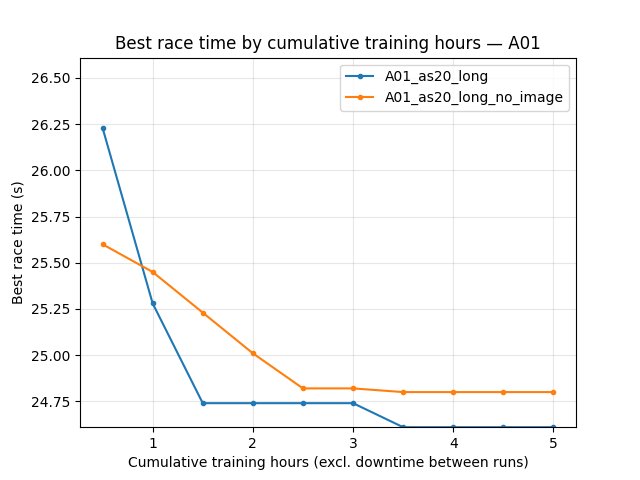
A01 best time: With image head (A01_as20_long) reaches better best times at every checkpoint. At 85 min: baseline 24.71s, no_image 25.02s. At 315 min: baseline 24.53s, no_image 24.79s (~0.26s gap). Float-only learns but plateaus ~0.2–0.3s slower.
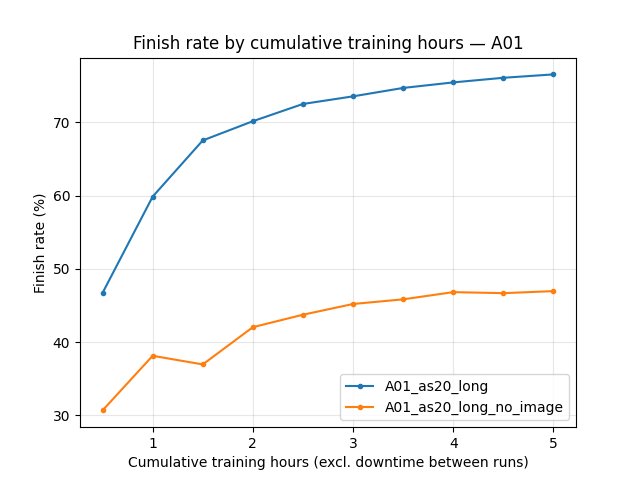
First finish: Baseline first finish 8.3 min, no_image 10.4 min. Finish rate at 85 min: baseline 53%, no_image 38%; by 315 min baseline 65%, no_image 47%.
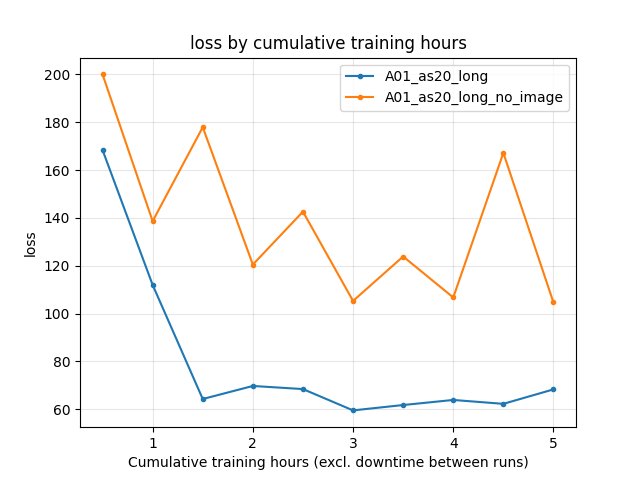
Training loss: Baseline lower throughout (e.g. at 85 min: 67.3 vs 177.9; at 315 min: 56.9 vs 96.1). Float-only has higher loss and more variance.
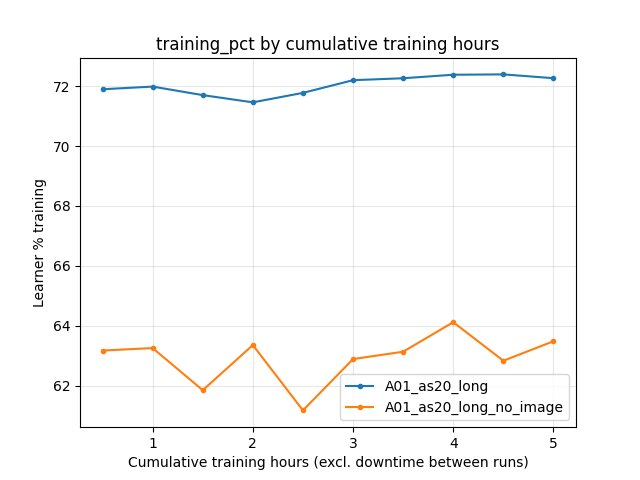
GPU utilization: Baseline ~71–72% learner training; no_image ~62–64% (smaller network, less compute per batch).
Conclusion: The image head improves sample efficiency and final A01 times; float-only is viable but consistently worse on this map.
Run Analysis
A01_as20_long (baseline):
use_iqn_image_head: true, batch_size 512, running_speed 512, map cycle 64× A01 + 1× eval. ~495 min (relative time). TensorBoard:tensorboard/A01_as20_long(+ _2, _3).A01_as20_long_no_image:
use_iqn_image_head: false, batch_size 512, running_speed 512, gpu_collectors_count 4, map cycle 64× A01 + 1× eval. ~320 min (relative time). Save dir:save/A01_as20_long_no_image; TensorBoard:tensorboard/A01_as20_long_no_image(+ _2, _3).
Comparison uses common window up to 320 min (shortest run). Reproduce: python scripts/analyze_experiment_by_relative_time.py A01_as20_long A01_as20_long_no_image --interval 5 --step_interval 50000.
Detailed TensorBoard Metrics Analysis
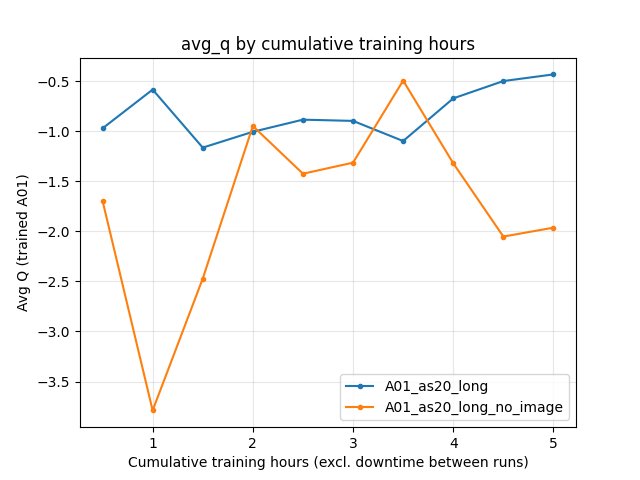
Methodology — Relative time and by steps: Metrics are compared at checkpoints 5, 10, 15, 20, … min (only up to the shortest run, 320 min) and at step checkpoints (BY STEP tables). For race times we use per-race events (best/mean/std, finish rate); for loss/Q/GPU% the last value at that moment. The figures below show one metric per graph (runs as lines, by relative time).
A01 (per-race eval_race_time_trained_A01, common window up to 320 min)
A01_as20_long (baseline): At 85 min best 24.71s, mean 28.27s, finish rate 53%; at 315 min best 24.53s, mean 26.27s, finish rate 65%. First finish 8.3 min.
A01_as20_long_no_image: At 85 min best 25.02s, mean 29.03s, finish rate 38%; at 315 min best 24.79s, mean 27.45s, finish rate 47%. First finish 10.4 min. Best time lags baseline by ~0.2–0.3s throughout.
Training Loss
A01_as20_long: At 85 min 67.3; at 315 min 56.9.
A01_as20_long_no_image: At 85 min 177.9; at 315 min 96.1. Float-only has higher loss and more variance over the run.
Average Q-values
A01_as20_long: At 315 min ~-0.92 (varies by checkpoint).
A01_as20_long_no_image: At 315 min ~-2.17. Both runs show fluctuating Q; no_image tends more negative in the second half of the window.
GPU Utilization (training %)
A01_as20_long: ~71–72% over the window.
A01_as20_long_no_image: ~62–64%. Smaller network (no CNN) yields slightly lower learner percentage.
Configuration Changes
Neural network (nn section in config YAML):
use_iqn_image_head: false # No CNN image head; IQN uses only float features.
Training (unchanged from default A01 long setup):
run_name: "A01_as20_long_no_image"
batch_size: 512
Performance:
gpu_collectors_count: 4
running_speed: 512
Map cycle: 64× A01 exploration, 1× A01 eval (same as other A01 long runs).
Hardware
Document GPU model, number of collectors, and system when you run the experiment (e.g. 4 GPU collectors, RTX 5090).
Conclusions
Float-only IQN (no image head) trains on the same float inputs and reaches a reasonable policy (A01 best ~24.79s by 315 min) but is consistently worse than the baseline with image head (~24.53s, ~0.26s faster) over the common window (320 min). First finish is later (10.4 min vs 8.3 min); finish rate stays lower; loss is higher.
The image head adds clear value on A01: better sample efficiency, lower loss, and better best times. Use float-only for ablation or when vision is unavailable; for best performance keep
use_iqn_image_head: true.
Recommendations
Use use_iqn_image_head: false for ablation (how much does vision help?) or when training without screen input.
For a fair comparison, keep batch_size, running_speed, map_cycle, and rewards identical; only change
use_iqn_image_head. Note: no_image run used 4 collectors vs 8 for baseline in config; durations differ (320 min vs 495 min), so comparison is by relative time only.
Analysis tools:
By relative time and by steps:
python scripts/analyze_experiment_by_relative_time.py <baseline_run> A01_as20_long_no_image [--interval 5] [--step_interval 50000](use--logdir "<path>"if not from project root). Outputs both relative-time and BY STEP tables.With comparison plots: add
--plot --output-dir docs/source/_static --prefix exp_iqn_no_image_headto the command above; then embed the generatedexp_iqn_no_image_head_*.jpgfiles in this RST.By last value only:
python scripts/analyze_experiment.py <baseline_run> A01_as20_long_no_image(less meaningful when durations differ).