Experiment: BTR (Beyond The Rainbow) on A01
Experiment Overview
This experiment tested the effect of enabling the full BTR recipe (paper-aligned components mirrored under btr: in the RL config) on long training for map A01.
Compared runs:
Baseline:
A01_as20_long_v2(BTR disabled)BTR variants:
A01_as20_long_v4_btr,A01_as20_long_v4.1_btr,A01_as20_long_v4.2_btr(BTR enabled)
Goal: determine whether BTR improves the best achievable A01 time and the learning dynamics (by equal training steps).
Results
Important: run wall-clock durations differ across BTR variants, so all “by time” conclusions are valid only on the common window shared by the compared runs (up to ~1600 wall-min; the shortest run is A01_as20_long_v4_btr).
Key findings:
Final best A01 time (save-state
alltime_min_ms['A01']): the baselinev2is substantially better than all BTR variants.BY STEP comparison at equal compute (10M and 20M steps) also shows
v2ahead on robust A01 eval best time.BTR improves some early/mid training metrics (e.g. earlier A01 “best-so-far” reached by ~60–90 wall minutes), but it does not translate into a better final record.
Run Analysis
Durations (wall minutes from the first merged TensorBoard event):
A01_as20_long_v2: ~2902 minA01_as20_long_v4_btr: ~1604 minA01_as20_long_v4.1_btr: ~2920 minA01_as20_long_v4.2_btr: ~2911 min
Detailed TensorBoard Metrics Analysis
The tables below summarize key metrics by (1) relative wall time (minutes from the first merged TensorBoard event) and (2) by training steps (common checkpoints on equal gradient updates).
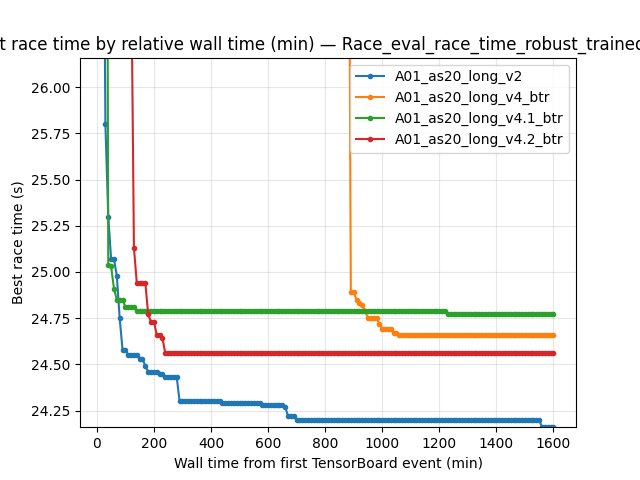
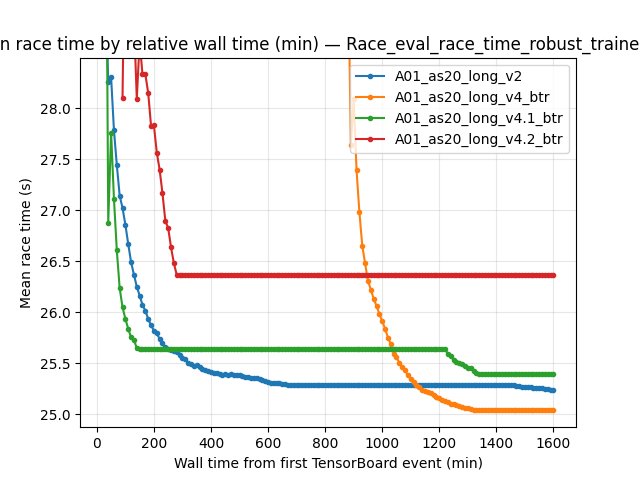
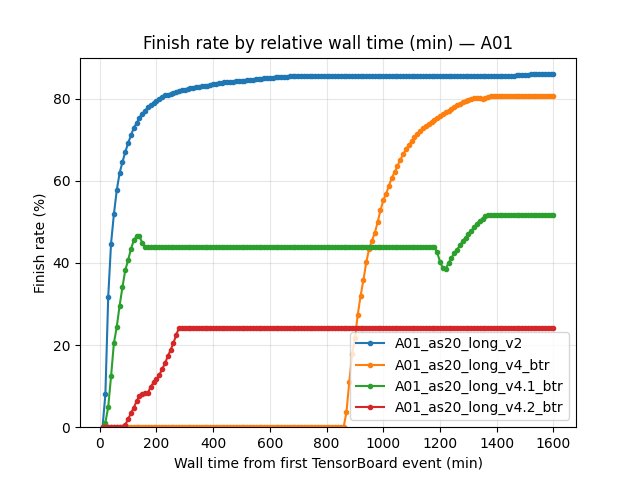
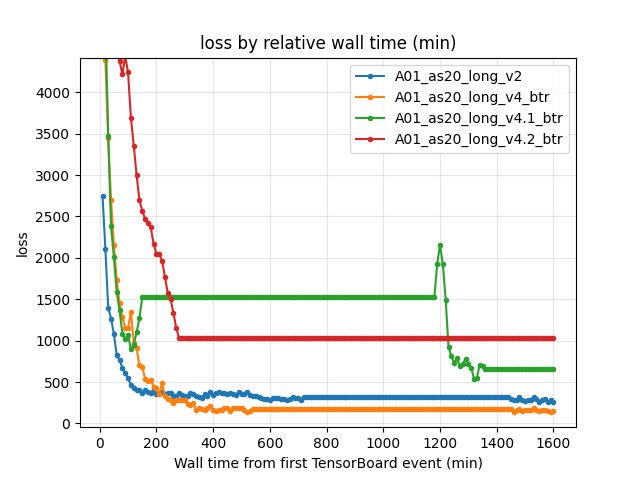
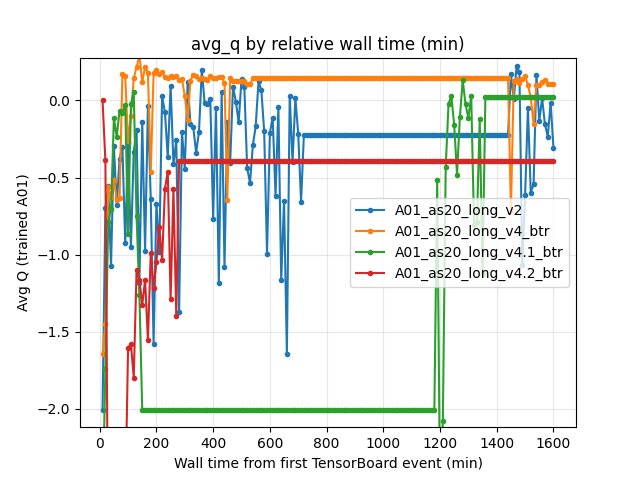
The figures below show one metric per graph (runs as lines) using relative wall time.
Methodology — common windows and checkpoints:
By relative time: evaluated at wall-minute checkpoints with interval 10 min, and interpreted only up to the common window (shortest run ended around ~1600 min).
By steps: evaluated only at common step checkpoints (here: 10M and 20M steps).
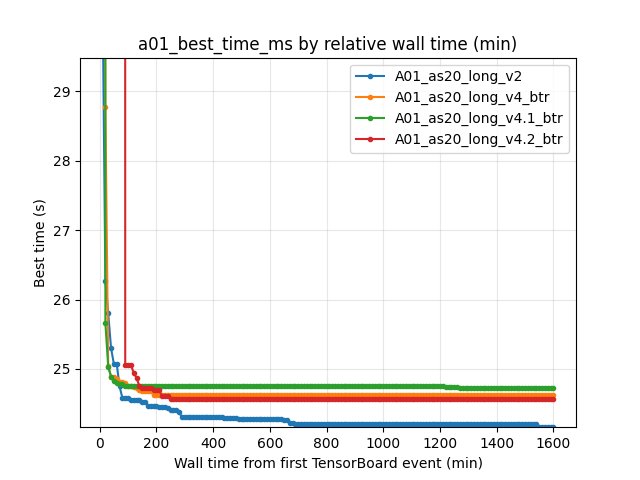
Map Performance (A01) — best so far
Metric: scalar alltime_min_ms_A01 (best race time achieved so far, seconds = ms/1000).
Values within the common wall-time window:
At 20 min:
v226.270s vsv4_btr28.780s vsv4.1_btr25.660s vsv4.2_btr300.000sAt 60 min:
v225.070s vsv4_btr24.850s vsv4.1_btr24.800s vsv4.2_btr300.000sAt 90 min:
v224.580s vsv4_btr24.790s vsv4.1_btr24.760s vsv4.2_btr25.060sAt 150 min:
v224.530s vsv4_btr24.680s vsv4.1_btr24.750s vsv4.2_btr24.730sAt ~1600 min (end of common wall window):
v224.160s vsv4_btr24.620s vsv4.1_btr24.720s vsv4.2_btr24.560s
Interpretation:
Early best-so-far (60–90 min) is often better for BTR than for v2. However, the baseline continues improving and ends with a much better final record.
Map Performance (A01) — robust eval best time (by steps)
Metric: per-race Race/eval_race_time_robust_trained_A01.
BY STEP checkpoints (common compute):
10M steps: -
v2best 24.580s (mean 26.74s, std 2.18s) -v4_btrbest 24.660s (mean 25.27s, std 1.25s) -v4.1_btrbest 24.770s (mean 25.39s, std 1.19s) -v4.2_btrbest 24.560s (mean 26.48s, std 2.52s)20M steps: -
v2best 24.460s (mean 25.80s, std 1.71s) -v4_btrbest 24.660s (mean 25.00s, std 0.86s) -v4.1_btrbest 24.700s (mean 25.16s, std 0.81s) -v4.2_btrbest 24.550s (mean 25.39s, std 1.68s)
Finish-rate columns were reported as - in this comparison output (consistent “finished” event mapping was not available for the robust tag within these checkpoints).
Training Loss (by steps)
Metric: scalar Training/loss (last value at the step checkpoint).
10M steps:
v2546.07 vsv4_btr269.78 vsv4.1_btr553.35 vsv4.2_btr1149.8420M steps:
v2351.09 vsv4_btr167.62 vsv4.1_btr283.07 vsv4.2_btr643.43
Average Q-values (by steps)
Metric: scalar RL/avg_Q_trained_A01 (last value at the step checkpoint).
10M steps:
v2-0.9310 vsv4_btr0.1308 vsv4.1_btr0.0269 vsv4.2_btr-1.396820M steps:
v2-0.6688 vsv4_btr0.0990 vsv4.1_btr0.0367 vsv4.2_btr-0.0931
Throughput / learner busy time (by steps)
Metric: scalar Performance/learner_percentage_training.
10M steps:
v260.8% vsv4_btr89.3% vsv4.1_btr73.2% vsv4.2_btr88.5%20M steps:
v261.1% vsv4_btr88.7% vsv4.1_btr78.5% vsv4.2_btr78.8%
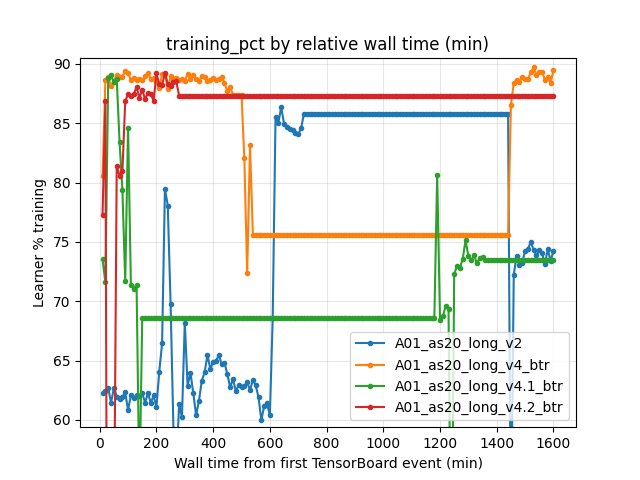
Takeaway:
BTR improves “learner training time share” in these runs (often much higher than the baseline), but A01 robust best time still favors v2 at equal step budgets.
Configuration Changes
Training / network setup differences between baseline and BTR runs:
Baseline (BTR disabled) —
A01_as20_long_v2
global_schedule_speed = 4dense_hidden_dimension = 1024,iqn_embedding_dimension = 128use_ddqn = true,clip_grad_norm = 30weight_decay_lr_ratio = 0.1
BTR enabled —
A01_as20_long_v4_btrandA01_as20_long_v4.1_btr
BTR bundle:
nn.vis.cnnIMPALA + maxpool + spectral norm on;btr:munchausen + layer norm + NoisyNet (use_munchausen,use_layer_norm,use_noisy_linear, etc.)dense_hidden_dimension = 1024,iqn_embedding_dimension = 128use_ddqn = true,clip_grad_norm = 30weight_decay_lr_ratio = 0.1global_schedule_speeddiffers: -v4_btr:global_schedule_speed = 4-v4.1_btr:global_schedule_speed = 1
BTR enabled (smaller network + softer optimizer) —
A01_as20_long_v4.2_btr
dense_hidden_dimension = 512,iqn_embedding_dimension = 64use_ddqn = false,clip_grad_norm = 10weight_decay_lr_ratio = 0global_schedule_speed = 1same BTR + vision bundle as above (reference
config_btr.yaml).
Hardware
gpu_collectors_countfrom config snapshots:8(parallel collectors)running_speed:32GPU model / device specifics were not captured in the config snapshots used for this write-up.
Conclusions
BTR is not a clear win for long A01 training in these experiments.
While BTR variants can produce better early “best-so-far” A01 times (common-window by wall minutes), the baseline
A01_as20_long_v2reaches a significantly better final best time.At equal step budgets (10M and 20M),
v2has better robust eval best time than most BTR variants (and ties/breaches only briefly depending on which BTR variant is considered).
Recommendations
If the goal is the best A01 record, keep
v2as the stronger baseline and treat these BTR configs as “early-learning positive but late-learning inferior”.Next BTR comparisons should extend the common BY STEP window beyond 20M steps and (optionally) use
--time-axis cumul_training_hoursto avoid wall-time calendar gaps.Consider ablations of BTR components (e.g. disable Munchausen or spectral norm first) to find which ingredient actually harms late-stage convergence on TM-style long training.